Blog
Last Week's Executive Order Is Bigger Than You Think. Your Procurement Team May Be Walking Into a Compliance Disaster.
The White House just issued an Executive Order that requires supply chain teams to identify and mitigate supply chain risks for every item across their Bills of Material within 45 days. Most supply chain teams are not prepared, but new industry tools can help.
Kipo Team·

In 2023, Lockheed Martin discovered that prohibited Chinese-origin magnets had entered the F-35 supply chain. The Department of Defense paused aircraft manufacturing for months while it investigated the exposure, considered alternatives and issued national-security waivers.
This was a well-resourced program with plenty of tools and consultants to support its supply chain team. Since 2020, the government had been combining internal information with commercial data to map the F-35 supply chain. By April 2025, it had first- and second-tier country-of-origin information for suppliers associated with approximately 30,000 of 40,000 targeted parts.
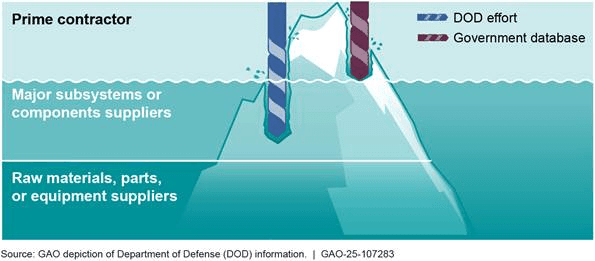
Yet it estimated that it knew the country of origin for less than 10% of the suppliers providing the underlying components and raw materials. The visibility systems the government and its contractors had in place became useful only after someone had already identified the problem.
The F-35 was not an isolated failure
Many more such problems still lurk beneath the surface today, and procurement leaders are well aware.
Supply-chain organizations have spent years responding to incidents with questionnaires, risk scores, dashboards and new layers of compliance. Many organizations are sitting on a wealth of data, but very few can move from their Bills of Material to the raw-material shortage that might threaten the products in them. In McKinsey’s 2025 supply-chain survey, only 42% of supply chain organizations reported having visibility into tier two of their supply chain.
Fewer orgs yet can address these challenges through alternate sourcing strategies. Most organizations are equipped to react only to the most severe supply chain incidents by devoting large teams of component engineers or sourcing managers to contain incident after incident, with virtually no meaningful future-looking risk mitigation program in place except for the most critical few items.
EO 14415 ends the era of voluntary supply-chain visibility
For years, the policy community has rallied for regulatory changes to prevent another F-35 magnet incident, observing that voluntary data sharing is not producing adequate results.
In one Defense Logistics Agency mapping effort, just five of 63 suppliers completed their survey submissions, negating much of the analysis’s value. Other government tools like DIBMAP have provided little visibility into the lower-tier suppliers furnishing raw materials, parts and equipment. In one example, a top-level view of the MQ-9 supply chain appeared concentrated in the United States and Europe, while a deeper investigation revealed Chinese integration further upstream.
Executive Order 14415 changes this landscape entirely.
While previous Executive Orders, such as President Biden’s 2021 Executive Order 14017 and Trump 1’s EO 13806, have moved in the direction of more resilient and secure American supply chains, EO 14415, signed July 20, 2026, goes much further.
The order requires part-level transparency, raw-material provenance, rapid reporting, mandatory mitigation and contractual consequences for defense contractors—all within 180 days.
Procurement and sourcing leaders are now scrambling to get their supply chains in shape before the guidance becomes policy. While the uncertainty is producing a feeling of apprehension, supply chain leaders are also seeing an opportunity for their organization to build an advantage by acting before compliance becomes a solicitation requirement.
Digging into the EO
EO 14415 contains three key provisions. First, it tightens an existing domestic-sourcing regime for critical materials. Defense acquisition rules already restrict the use of certain magnets, metals and alloys sourced from covered countries. Until now, agencies often waived these restrictions when compliant sources were unavailable, a common occurrence as the United States was completely import-reliant for 12 of 50 listed critical minerals and more than 50% import-reliant for 28. EO 14415 makes these waivers substantially harder to obtain, beginning January 1, 2027.

Second, contractors and subcontractors must submit a complete bill of materials, tracing components, parts, equipment, software and materials back to their raw-material origins. They must also quantify financial, ownership, and production risk, including capacity constraints, obsolescence, material disruption, sole-source dependencies, excessive concentration and limited surge capacity.
Finally, it requires contractors to respond to risks by submitting a corrective-action plan describing completed mitigations within 45 days of submission.
Failure to qualify an alternative source may become grounds for suspending or terminating task orders, declining to exercise options, or terminating an existing contract. Suppliers cannot afford to fall short.
Why supply chain teams are scrambling
Supply chain teams are used to evaluating risks and build risk mitigation strategies. But this Order changes the status quo dramatically by extending this work across the entirety of the contractor’s Bill of Material and turning scrutiny to production-related risks.
Today’s supply chain intelligence tools include tools like Exiger, Govini, Altana, and Interos. But these tools have serious shortcomings. An Air Force evaluation of three commercial illumination tools found results that were only 60% to 70% accurate, including both false risks and missed suppliers. Another program office found that too many relationships produced by one tool were unverified to be relied upon. These findings expose a category-wide problem: an inferred supplier graph does not meet the requirements of the EO.
The industry lags especially far behind in understanding production risk areas and mitigating these risks. They require understanding specifications, drawings, datasheets, approved manufacturers, and form-fit-function equivalence, something that virtually no tools in the industry today meet. Two components can share a category, package and broad electrical description while differing in tolerances, materials, qualification status or operating conditions. Reading the associated drawings and datasheets—and connecting those findings to an affected BOM—is difficult, technical work that few tools fully support.
The 45-day timeline accentuates this challenge. Typically, alternate sourcing and mitigation strategies require large teams of sourcing personnel with expertise in the specific commodity category impacted by the risk. Doing that within 45 days across the entirety of a Bill of Materials is a steep timeline for the degree of work involved.
Supply chain teams equipped with last generation’s tools are walking into serious compliance challenges. The 180 day clock has already started.
New technology for a new era in supply chain
EO 14415 recognizes that the scale of the problem demands new technology. It explicitly directs the government to analyze acquisition information “using any tools and technologies to include artificial intelligence to assist in doing so.”
Supply chain teams must follow suit. Software engineering teams have seen dramatic productivity improvements from the use of AI in their daily work, led by a few domain-specific tool providers like Cursor and Claude Code with AI central to their mission. By contrast, offerings that tacked on AI to legacy product suites like Github Copilot were quickly outpaced in their capabilities by “AI-Native” coding platforms.
The supply chain domain is quickly moving in the same direction. Tools like Kipo AI direct AI “agents” to read drawings and datasheets, normalize part identities, identify technical requirements, connect evidence to BOM lines, surface likely risks and propose technically plausible alternative components, closing the gap between identified risks and corrective action.
Such tools drastically increase the speed and productivity of supply chain users. The new generation of tools, using AI at their core to transform supply chain work rather than as a peripheral add-on to legacy data platforms, enable supply chain teams to keep up with the dramatic increase in their workloads that is pending within 180 days.
The bottom line
The supplier databases, mapping efforts, and intelligence of the pre-AI era fell short of the extraordinary complexity and risk involved in building and sustaining modern defense programs like the F-35. Today, we are seeing the tools bridge a supply chain gap that the defense community has long drawn attention to.
Future-looking organizations have begun integrating AI agents into their procurement processes. Letterkenny Army Depot manages ongoing obsolescence challenges for the PATRIOT and HIMARS system using the Kipo AI platform, and cutting-edge Primes are implementing the platform’s AI agents to proactively build alternate sourcing strategies in advance of the EO’s implementation.
These organizations are preparing for a Department of War that no longer accepts partial visibility into its supply chains. When the 180-day deadline hits, will your organization be one of them?